

Home
a community of scholars and creative writers
engaging with literature in national and global contexts.
Who We Are
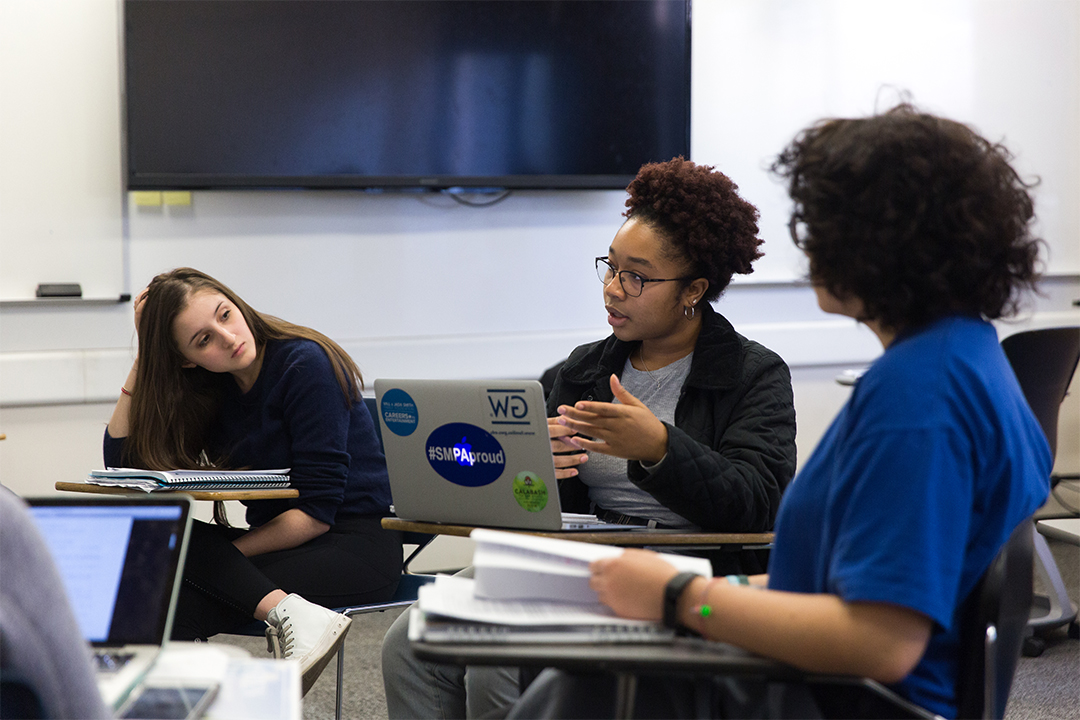
The George Washington University Department of English offers comprehensive training in critical theory and literary and cultural studies, exposing students to a diversity of texts across global and transnational lines.
From Beowulf to Derek Walcott, from Virginia Woolf to Sojourner Truth, courses explore the human experience with thoughtful attention to style and content. Undergraduate and graduate students trace the ways in which English expressions can bridge cultures and shape perception, whether through ancient manuscripts, hip hop lyrics or graphic novels.
Beyond the classroom, the English Department hosts seminars and lectures on poetry, drama, film, literature and theory for the GW campus community. Our location in the heart of Washington, D.C., provides rich opportunities for internships and scholarly research — from the Library of Congress and the Folger Shakespeare Library to the Washington Metropolitan Area Consortium of Local Universities.
A Letter from the Chair
Welcome to the English Department!
We play a vital role in advancing the mission of the Columbian College of Arts and Science at the George Washington University to guide students in examining the world through literary and cultural studies and creative writing. With our major in English, our major in Creative Writing and English, our three minors (English; Creative Writing and English; Asian American Studies), two micro-minors (Disability Studies and Immigration and Migration Studies), and our M.A. and Ph.D. programs, we offer excellent research, teaching, and leadership from our base in literary and cultural studies and creative writing. Our classes offer individualized attention to students' writing and intellectual development, and our faculty have won university prizes for their teaching (Alexa Joubin) and graduate mentoring (Holly Dugan). We celebrate recent and upcoming publications on Shakespeare (Holly Dugan and Alexa Joubin), Jane Austen (Maria Frawley), the environmental afterlives of slavery (Jennifer James), Trans studies (Alexa Joubin), disability studies in the Middle Ages, in Nazi Germany, and in the present (Jonathan Hsy, David Mitchell, and Robert McRuer); Asian Americans and racial care (James McMaster), luminous poetry and personal essays (Chet’la Sebree), and new novels (Jung Yun, Aaron Hamburger.)
We're pleased to welcome visiting Professors Nandi Comer, Aaron Hamburger, and Lesley Thulin, and all our incoming and returning students, graduate and undergraduate.
We look forward in 2026-27 to the Woven Words Poetry Readings (Sept. 11 and springtime); student visits to the Folger Library and the AWP conference for writers; exciting scholarly talks on AI (Lisa Duggan, Sept. 24), Toni Morrison, Jane Austen, and the experiences of writing and cooking during the English Renaissance; intimate readings by creative writers Nandi Comer, Chet'la Sebree, Lacey Dunham, Wil Haygood, Alison Powell, and Megha Majumdar, and many other joys.
Patty Chu
Professor and Chair